


Description
PrymaLab · Research Use Only
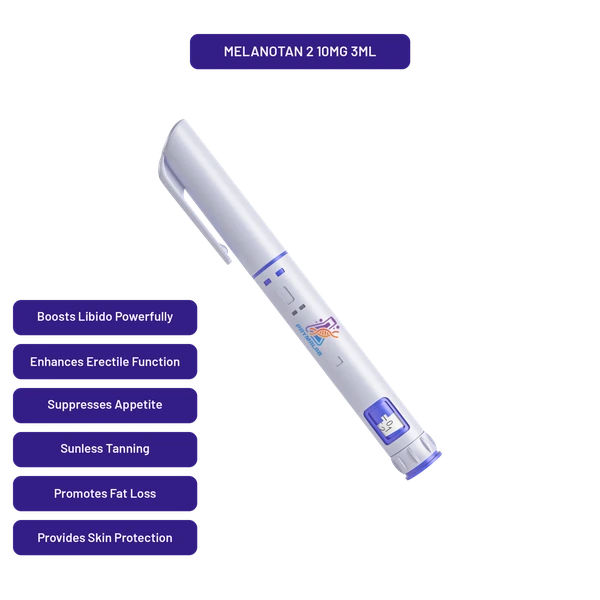
Preloaded Autoinjector | Melanotan 2 | 3ml Pen | 10mg
Lactam-bridged melanocortin heptapeptide in solution · 3ml at 3.33mg/ml · No reconstitution step
The melanotan 2 pen is a preloaded 3ml research device holding Ac-Nle-cyclo[Asp-His-D-Phe-Arg-Trp-Lys]-NH2 in solution at 3.33mg/ml, giving 10mg in total. The side-chain lactam bridge locks the ring and blocks the aspartimide chemistry that troubles linear peptides, which leaves tryptophan oxidation and slow amide hydrolysis as the routes that matter in a cartridge.
Specification Table
| Property | Value |
|---|---|
| Device format | Preloaded autoinjector pen, glass cartridge |
| Fill volume | 3 ml |
| Concentration | 3.33 mg/ml |
| Total compound in device | 10 mg |
| Molar concentration | 3.25 mM |
| Compound | Melanotan 2, Ac-[Nle4, Asp5, D-Phe7, Lys10]-alpha-MSH(4-10)-NH2. UNII UPF5CJ93X7 |
| CAS number | 121062-08-6 (free peptide). No separate acetate CAS verified |
| Molecular formula | C50H69N15O9 |
| Molecular weight | 1024.20 g/mol average; 1023.54 monoisotopic |
| Amino acid sequence | Ac-Nle-cyclo[Asp-His-D-Phe-Arg-Trp-Lys]-NH2, 7 residues |
| Solution appearance | Not published on the product record. Confirm against certificate of analysis |
| Reconstitution required | None. Supplied as solution |
| Excipient system | Not published on the product record. Confirm against certificate of analysis |
| Solution pH | Not published on the product record |
| Storage | 2-8°C, protected from light, do not freeze |
| Light sensitivity | Material. Trp absorbs at 280 nm and gives coloured kynurenine photoproducts |
| Solution stability | No forced-degradation or long-term aqueous study of this compound has been published |
| Cyclisation | 23-membered side-chain lactam between the Asp beta-carboxyl and the Lys epsilon-amine. No cysteine, no disulfide |
| Measured constants | His pKa 6.54, Arg pKa 11.72, log P 2.82 at pH 7.35 (Lan 1994) |
| Salt form | Acetate; trifluoroacetate if not exchanged. Unverified per lot |
| Purity | Per lot-specific certificate of analysis |
| Regulatory status | Never approved by FDA, EMA, PMDA, TGA or Health Canada. Two relatives are approved: afamelanotide (Scenesse) and bremelanotide (Vyleesi, NDA 210557, 2019). This research preparation is neither of those products |
What Changes When Melanotan 2 Ships in Solution?
Less than for most peptides, for a structural reason: the lactam bridge that makes this molecule superpotent also makes it chemically quiet, so the question is what the ring does not protect.
The 23-membered side-chain lactam joins the beta-carboxyl of Asp5 to the epsilon-amine of Lys10, so the aspartate side chain cannot fold back onto the backbone and the succinimide and isoAsp chemistry that dominates linear peptide degradation is suppressed. The N-terminus is acetylated, so there is no free amine and therefore no pyroglutamate route and no diketopiperazine cleavage. Add the absence of cysteine, methionine, asparagine, glutamine, tyrosine and serine, and disulfide scrambling, thioether oxidation and deamidation go too.
Three routes remain. Tryptophan is the first. It oxidises to hydroxytryptophan at plus 16 daltons, to N-formylkynurenine at plus 32 and to kynurenine at about plus 4, and photo-oxidises under near-ultraviolet light. The kynurenine-type products absorb in the near-visible, so yellowing is a visible indicator of a chemical event and the only degradation signal here that needs no instrument.
Histidine is the second. Metal-catalysed oxidation converts it to 2-oxo-histidine, a route needing only trace copper or iron plus dissolved oxygen. Lan and colleagues measured its pKa at 6.54 in 1994, so the imidazole changes protonation state across the ordinary formulation window of pH 5 to 8, and with it the peptide’s net charge and adsorption behaviour. Arginine at pKa 11.72 stays cationic throughout.
The third route is the interesting one. The C-terminal lysinamide slowly hydrolyses to the free acid, and that free acid is bremelanotide: C50H68N14O10 at 1025.2, one dalton heavier, identified as a metabolite in the original Arizona trials and approved by FDA in 2019 as Vyleesi. A solution left long enough at the wrong pH does not simply lose potency. It converts, slowly, into a different melanocortin agonist with a different receptor preference, and the 1 dalton difference is one no routine assay of a research preparation resolves.
Physical behaviour is less settled. The molecule is amphipathic, with a log P of 2.82 at pH 7.35 and a net charge of roughly plus 1 to plus 2 across pH 4 to 6, the classic profile for self-association and for adsorption to glass and polyethylene. Nobody has measured self-association at the 3.33 mg/ml of a melanotan 2 pen. The nearest evidence is that Vyleesi is formulated at 5.83 mg/ml in 2.5 percent glycerin with no surfactant.
Melanotan 2 Solution Stability: What Has Been Studied
No forced-degradation study and no long-term aqueous stability study of this compound has ever been published, which is a striking gap for a peptide first described in the late 1980s.
What exists is preformulation work: Lan and colleagues reported pKa values, partition coefficients and 4.6 percent oral bioavailability in rats in 1994, and Kilpelainen and colleagues loaded the peptide into porous silicon microparticles at 15 percent by weight in 2011. Neither addressed melanotan 2 solution stability over months in a sealed container, which is what a preloaded device raises.
The most useful indirect evidence comes from the approved relative. Vyleesi holds 1.75 mg in 0.3 ml, a ready-to-use solution formulated with 2.5 percent glycerin and water with hydrochloric acid or sodium hydroxide for pH adjustment, stored at or below 25°C, not frozen, protected from light. A melanocortin peptide of this family therefore survives as a room-temperature aqueous solution when the formulation has been validated. The word doing the work in that sentence is validated, and no equivalent validation exists for a melanotan 2 pen. Refrigeration at 2-8°C is the conservative position in its absence.
Does Melanotan 2 Come in a Pen?
Yes. The search “does melanotan 2 come in a pen” is answered by this device: a 3ml preloaded autoinjector holding 10mg already in solution at 3.33mg/ml.
The format has a regulatory precedent in the same peptide family, which is unusual for this catalogue. Bremelanotide, the free-acid analogue, is supplied as a single-dose autoinjector delivering 1.75 mg in 0.3 ml at 5.83 mg/ml, with a validated formulation and a defined shelf life; this is a multi-dose research cartridge with neither. The engineering is comparable, the evidence behind it is not. Other devices, including the related melanocortin PT-141 autoinjector, are on the preloaded autoinjector category page.
What Does the Melanotan 2 Pen Deliver Per Increment?
Ten milligrams in 3 ml gives 3.33 mg/ml, which at a molecular weight of 1024.20 is 3.25 mM. Each 0.01 ml graduation carries 33.3 micrograms or 32.5 nanomoles, each 0.1 ml 333 micrograms or 325 nanomoles.
Those figures become meaningful against the published quantities. The Arizona group worked in the low-milligram range per administration under clinical supervision. The single 6 mg self-injection that produced rhabdomyolysis in the case Nelson and colleagues reported in 2012, with creatine kinase at 17,773 IU per litre and a heart rate of 146, corresponds to 1.8 ml of this cartridge. One melanotan 2 pen therefore holds several times the quantity behind a documented toxic exposure.
At the other end of the scale, melanocortin-1 receptor half-maximal effect concentrations sit in the sub- to low-nanomolar range. Reaching 1 nM from 3.25 mM is a 3.25-million-fold serial dilution, four or five sequential steps rather than one, and each step is a place for error to enter. The dilution calculator is faster than reconstructing that afterwards.
Melanotan 2 Pen vs Vial: What Actually Changes
The melanotan 2 pen vs vial comparison usually gets framed around reconstitution, and for this compound a second issue matters more: what is actually in the container.
Breindahl and colleagues characterised products sold as this peptide online by liquid chromatography with ultraviolet and tandem mass detection in 2015, and Mestria and colleagues repeated the exercise in 2021. Between them they found 4.32 to 8.84 mg in vials labelled 10 mg, with unidentified impurities running 4.1 to 5.9 percent in some samples. A pen does not fix that. It fixes concentration relative to whatever went in, and removes reconstitution errors: diluent measurement, incomplete dissolution, shear and adsorptive transfer loss. Content accuracy still comes from the lot certificate and independent quantitation.
Where the device earns its place is repeated equivalent draws from one lot, an argument set out in the pen and vial comparison. A lyophilized 10mg vial of the same compound keeps the tryptophan dry until the day it is used, which for a photo-oxidisable residue is a real advantage. An intranasal preparation of the same compound covers work where route is the variable.
Melanotan 1 vs 2: What Separates Them
The melanotan 1 vs 2 question has a structural answer and a regulatory one.
Structurally, afamelanotide is linear: [Nle4, D-Phe7]-alpha-MSH, a 13-residue analogue of the natural hormone. This compound is a cyclic heptapeptide, shortened to the 4-10 message sequence and closed with a lactam bridge. That constraint raises potency and protease resistance and broadens receptor engagement: it is a non-selective agonist across MC1R, MC3R, MC4R and MC5R, and the hypothalamic MC4R component is what produced the erections, yawning, stretching and nausea recorded in the Arizona studies. Pigmentation runs through MC1R, which raises melanocyte cyclic AMP and eumelanin synthesis.
Regulatorily the gap is wider. Afamelanotide is approved for erythropoietic protoporphyria under the trade name Scenesse. Bremelanotide, the free-acid analogue of this molecule, is approved as Vyleesi under NDA 210557. This compound has never been approved anywhere. The linear analogue is stocked separately for comparative work.
What the Product Record Does Not State
Four fields are absent, and for this compound the pH is the one that decides how fast the molecule turns into something else.
Solution pH is not published on the product record, and amide hydrolysis at the C-terminal lysinamide, the reaction that converts this peptide into bremelanotide, is acid- and base-catalysed. Excipient system: not published on the product record. Confirm against certificate of analysis, asking in particular whether a chelator is present, since histidine oxidation is metal-catalysed.
Solution appearance and fill date are also absent from the melanotan 2 pen record. Appearance matters more here than for most peptides, since a yellow tint is the readable endpoint of tryptophan photo-oxidation, and a baseline recorded at fill is what makes a later observation interpretable.
Verifying a Melanotan 2 Pen and Its Contents
Tryptophan gives this compound a real ultraviolet handle, so a diluted aliquot read at 280 nm returns a concentration estimate independent of the label, worth doing once per lot for a compound with a documented history of under-filled containers.
Run the full spectrum rather than a single wavelength. Absorbance appearing between 320 and 400 nm indicates kynurenine-type photoproducts, and that signal precedes any visible yellow. Compare against a reference prepared the same day from a lyophilized lot rather than a literature extinction coefficient obtained in an unknown buffer.
Mass spectrometry answers the more specific questions. The parent sits at 1024.2 average mass, tryptophan oxidation shows as plus 16 and plus 32 satellites, and histidine oxidation to 2-oxo-histidine also adds 16, which is why chromatographic retention shift matters as much as mass. Conversion of the lysinamide to the free acid adds 1 dalton and gives bremelanotide at 1025.2; resolving a plus 1 species against the isotope envelope of a 1024 dalton molecule needs high-resolution instrumentation rather than a routine quadrupole.
For the device itself: allow the cartridge to reach ambient temperature before actuating, since cold solution is more viscous and viscosity alters delivered volume; verify delivered mass gravimetrically once; and inspect each draw against a white card for particulate and tint.
What the Human Literature Reports
The entire human efficacy record is three University of Arizona studies between 1996 and 2000 in roughly 33 men, after which development moved to the free-acid analogue.
Dorr and colleagues published an open pilot phase I study in Life Sciences in 1996: three healthy men, subcutaneous administration Monday to Friday for two weeks, escalating from 0.01 to 0.025 and 0.03 mg per kilogram. They reported pigmentation of the face, upper body and buttocks after five administrations in two of the three participants, along with nausea, stretching and yawning, spontaneous erections, and grade II somnolence at the highest level. Wessells and colleagues followed with a double-blind placebo-controlled crossover study in men with psychogenic erectile dysfunction in 1998, and a further crossover study in 20 men reported in 2000: erection in 17 of 20 without sexual stimulation, a mean 41 minutes above 80 percent rigidity, increased desire after 68 percent of active administrations against 19 percent of placebo, and severe nausea after 12.9 percent of administrations at 0.025 mg per kilogram.
There is no phase II or phase III programme, no registered trial and no NCT number. Rodent work is far more extensive, covering feeding, thermogenesis, insulin sensitivity and erectile function, with PubMed listing 55 titles containing the compound name. Controlled pigmentation efficacy, long-term safety, prospective melanoma risk and the stability of a multi-dose device have none of them been studied.
The case literature is where the harm signals sit, and it reads as data rather than as warning labels. Schulze and colleagues reported eruptive naevi and darkening of existing naevi within 24 hours of a single injection in 2014, Hjuler and Lorentzen melanoma associated with use in the same year, Nelson and colleagues rhabdomyolysis and acute kidney injury after a 6 mg injection in 2012, Devlin and colleagues priapism after overdose in 2013, and Peters and colleagues renal infarction in 2020. Case reports of oral mucosal changes with intranasal products appeared in 2025 and 2026.
Safety and Regulatory Position
This compound has never been approved by FDA, EMA, PMDA, TGA or Health Canada, and FDA has stated its position on the record in an enforcement document rather than only in guidance.
Federal Register document 2016-27244, published 14 November 2016, sets out a debarment order against Edward Manookian, owner of Melanocorp Inc. of Tennessee, convicted on 28 August 2015 in the Middle District of Tennessee on two counts of conspiracy under 18 USC 371 for shipping this peptide sold online as an injectable tanning product after assuring FDA he would stop. The order records FDA’s position that the substance constituted a new drug under the Federal Food, Drug, and Cosmetic Act that could not enter interstate commerce without an approved application. Multiple national agencies have issued warnings about unregulated melanocortin products, reviewed by Habbema and colleagues in 2017 and by Adler and colleagues in Australia the same year.
It is not a component of an approved drug, has no USP monograph and is not on the 503A bulks list, so it is ineligible for compounding in the United States, and it was absent from the agenda of FDA’s Pharmacy Compounding Advisory Committee meeting of 23 and 24 July 2026. It is not named individually on the WADA Prohibited List, where non-approved substances fall under section S0. The device is supplied into laboratory research only, and administration to humans or animals is not a use it is sold for.
What Is the Mechanism of Action at the Melanocortin Receptors?
Melanotan 2 is a cyclic analogue of alpha-melanocyte-stimulating hormone, and its mechanism of action is broad agonism across the melanocortin receptors rather than action at one of them. There are five: MC1R on melanocytes, MC2R for ACTH in the adrenal cortex, MC3R and MC4R in the central nervous system, and MC5R in exocrine glands. Melanotan II binds MC1R, MC3R, MC4R and MC5R with meaningful affinity, and every reported effect maps onto one of those.
Skin pigmentation comes from MC1R. Agonism there switches the pigment cells from producing red-yellow pheomelanin to producing brown-black eumelanin, which is the whole of melanogenesis in this context, and increased melanin production is what produces the tanning effect the compound is sold for. Melanin production of that kind is a change in pigment type as much as in pigment quantity. The response is greater in people whose MC1R already functions well and weaker in those carrying loss-of-function variants, which is the same genetics that governs whether someone tans or burns in ordinary sun exposure.
The other effects come from the brain receptors. MC4R agonism suppresses appetite, which is where the appetite suppression and weight loss reports originate, and appetite suppression is the effect users most often describe alongside the tan, and MC3R and MC4R together mediate the effects on sexual arousal and libido that made this molecule interesting to pharmacology in the first place. Bremelanotide, a metabolite of MT-II, was developed on exactly that observation and is approved as Vyleesi for hypoactive sexual desire disorder in premenopausal women. Sexual function effects reported for Melanotan II are the same pharmacology at a less selective receptor profile.
Melanotan I and Melanotan II Are Different Compounds
Melanotan I is afamelanotide, a linear 13-residue analogue that binds predominantly, though not exclusively, to MC1R. It is an approved medicine, marketed as Scenesse, given as a 16 mg subcutaneous implant for erythropoietic protoporphyria in the European Union since 2014 and the United States since 2019, and its receptor preference means it produces pigmentation without the central effects. Melanotan I has a label, registrational trials and post-marketing surveillance.
Melanotan II has none of those. It is a cyclic seven-residue analogue with broad receptor coverage, it was never developed to approval by anyone, and no regulator has authorised it in any jurisdiction. The two names differ by one character and the products differ by approval status, receptor selectivity and side effect profile. Anyone reading the Scenesse literature as evidence for Melanotan II is reading the wrong drug.
What Do the Regulators and the Case Reports Say?
They have been saying the same thing for over fifteen years. The MHRA in the United Kingdom has repeatedly warned against unlicensed tan jabs, and tan jabs sold as injections or as nasal sprays have been the subject of seizure actions and public warnings there and in Ireland, Norway, Sweden, Denmark and Australia. Tan jabs bought online carry no assurance of identity, purity or sterility, and the tabloid nickname barbie drug attached to this compound has done nothing to slow that market.
The medical literature is a series of case reports rather than a trial programme, and its content is consistent. Reported side effects include nausea and vomiting after injection, facial flushing, headache, spontaneous penile erection in men, and darkening of existing moles. Those side effects come from individual case reports rather than from a trial, so their frequency is unknown. That last one is the finding that matters most. Multiple published reports describe rapid change in melanocytic naevi in users, and several describe the disease being diagnosed after use. Causation has not been established in a controlled study and cannot be from case reports alone, but the pharmacology gives the concern a mechanism: a compound that drives melanocyte activity is being used by people who also seek UV exposure, and UV exposure is the established melanoma risk factor.
Other reported harms include rhabdomyolysis, renal infarction and impairment, and posterior reversible encephalopathy syndrome. Sexual dysfunction is not among the reported effects; the reverse is, with prolonged erections requiring medical attention in several reports. None of this constitutes a safety database, because there has never been a trial to build one, and this device is supplied for laboratory research only.
Published Literature
Each reference below was confirmed in PubMed or Crossref before it was listed. None of them studied a multi-dose device or this concentration.
- Dorr RT, Lines R, Levine N, et al. Evaluation of melanotan-II, a superpotent cyclic melanotropic peptide in a pilot phase-I clinical study. Life Sci. 1996;58(20):1777-1784. DOI: 10.1016/0024-3205(96)00160-9
- Wessells H, Fuciarelli K, Hansen J, et al. Synthetic melanotropic peptide initiates erections in men with psychogenic erectile dysfunction: double-blind, placebo controlled crossover study. J Urol. 1998;160(2):389-393. DOI: 10.1097/00005392-199808000-00025
- Wessells H, Levine N, Hadley ME, et al. Melanocortin receptor agonists, penile erection, and sexual motivation: human studies with Melanotan II. Int J Impot Res. 2000;12(Suppl 4):S74-S79. DOI: 10.1038/sj.ijir.3900582
- Lan EL, Ugwu SO, Blanchard J, et al. Preformulation studies with melanotan-II: a potential skin cancer chemopreventive peptide. J Pharm Sci. 1994;83(8):1081-1084. DOI: 10.1002/jps.2600830805
- Nelson ME, Bryant SM, Aks SE. Melanotan II injection resulting in systemic toxicity and rhabdomyolysis. Clin Toxicol (Phila). 2012;50(10):1169-1173. DOI: 10.3109/15563650.2012.740637
- Breindahl T, Evans-Brown M, Hindersson P, et al. Identification and characterization by LC-UV-MS/MS of melanotan II skin-tanning products sold illegally on the Internet. Drug Test Anal. 2015;7(2):164-172. DOI: 10.1002/dta.1655
- Habbema L, Halk AB, Neumann M, et al. Risks of unregulated use of alpha-melanocyte-stimulating hormone analogues: a review. Int J Dermatol. 2017;56(10):975-980. DOI: 10.1111/ijd.13585
- Hjuler KF, Lorentzen HF. Melanoma associated with the use of melanotan-II. Dermatology. 2014;228(1):34-36. DOI: 10.1159/000356389
Frequently Asked Questions
What is the melanotan 2 pen?
A preloaded 3ml research device holding Ac-Nle-cyclo[Asp-His-D-Phe-Arg-Trp-Lys]-NH2 in solution at 3.33mg/ml, giving 10mg in total, with no reconstitution step. It is supplied strictly for laboratory research. This compound has never been approved by any regulator in any jurisdiction.
What does the lactam bridge change about solution behaviour?
It ties the aspartate side chain into an amide bond, so the succinimide and isoAsp chemistry that dominates linear peptide degradation is suppressed. The 23-membered ring joins the Asp5 beta-carboxyl to the Lys10 epsilon-amine, which also raises potency and protease resistance. It does not protect the tryptophan.
Which residues degrade in a cartridge?
Tryptophan and histidine. Tryptophan oxidises to hydroxytryptophan at plus 16 daltons, N-formylkynurenine at plus 32 and kynurenine at about plus 4, and photo-oxidises under near-ultraviolet light. Histidine converts to 2-oxo-histidine by metal-catalysed oxidation, which needs only trace copper or iron plus dissolved oxygen.
Does this peptide turn into anything else in solution?
Yes. The C-terminal lysinamide slowly hydrolyses to the free acid, and that free acid is bremelanotide at 1025.2 daltons, one dalton heavier, approved by FDA in 2019 as Vyleesi. The reaction is acid- and base-catalysed, so the unpublished formulation pH governs how fast it runs.
Has melanotan 2 solution stability been measured?
No. No forced-degradation study and no long-term aqueous stability study of this compound has been published. Lan 1994 gives preformulation constants and Kilpelainen 2011 describes porous silicon loading at 15 percent by weight, but neither addresses shelf life in a sealed container.
What does one 0.01 ml increment deliver?
33.3 micrograms, which is 32.5 nanomoles at a molecular weight of 1024.20. A 0.1 ml movement delivers 333 micrograms or 325 nanomoles. The full device holds 10mg at 3.33mg/ml, a molar concentration of 3.25 mM across the 3 ml fill.
How does the device volume compare with published quantities?
The Arizona studies worked in the low-milligram range per supervised administration. A 10 mg cartridge holds several times the 6 mg quantity behind the rhabdomyolysis case report of 2012, which is the comparison worth carrying.
Does melanotan 2 come in a pen as well as a vial?
Yes. This 3ml preloaded autoinjector holds the compound already in solution, alongside the lyophilized vial and an intranasal presentation. The closest regulatory precedent is bremelanotide, supplied as a single-dose autoinjector delivering 1.75 mg in 0.3 ml at 5.83 mg/ml with a validated formulation.
Melanotan 2 pen vs vial: does a pen improve content accuracy?
No. Published analyses found 4.32 to 8.84 mg in vials labelled 10 mg, with unidentified impurities at 4.1 to 5.9 percent in some samples. A device fixes concentration relative to whatever went in and removes reconstitution errors. Content accuracy still comes from the lot certificate and independent quantitation.
Melanotan 1 vs 2: what is the structural difference?
Afamelanotide is linear, a 13-residue analogue of alpha-MSH. This compound is a cyclic heptapeptide shortened to the 4-10 message sequence and closed with a side-chain lactam. The constraint raises potency and protease resistance and broadens receptor engagement across MC1R, MC3R, MC4R and MC5R.
How should the device be stored?
At 2-8°C, protected from light, without freezing. Tryptophan photo-oxidation is the specific reason for the light instruction, and the coloured kynurenine products are the visible endpoint. Bremelanotide is labelled for storage at or below 25 degrees, but that allowance rests on validation which does not exist for this preparation.
What is not published on the product record?
Solution pH, the excipient system, solution appearance and fill date. Ask specifically whether a chelator is present, since histidine oxidation is metal-catalysed and trace copper or iron in the water is enough to drive it. Ask also whether the counterion is acetate or residual trifluoroacetate.
How can contents be checked without a dry cake to inspect?
Through the tryptophan. A diluted aliquot read at 280 nm gives a label-independent concentration estimate, which matters for a compound with a documented history of under-filled containers. Absorbance appearing between 320 and 400 nm indicates kynurenine photoproducts before any yellow tint is visible.
What does the human evidence consist of?
Three University of Arizona studies between 1996 and 2000 in roughly 33 men. Dorr 1996 was an open pilot in three healthy men. Wessells 1998 and 2000 were placebo-controlled crossover studies in men with erectile dysfunction. There is no phase II or III programme, no registered trial and no NCT number.
What harms appear in the case literature?
Eruptive naevi and darkening of existing naevi within 24 hours of a single injection (Schulze 2014), melanoma associated with use (Hjuler 2014), rhabdomyolysis and acute kidney injury after a 6 mg injection (Nelson 2012), priapism after overdose (Devlin 2013) and renal infarction (Peters 2020).
What is the documented FDA position on this compound?
Federal Register document 2016-27244 of 14 November 2016 records a debarment order against the owner of Melanocorp Inc., convicted on 28 August 2015 on two conspiracy counts for shipping the peptide as an injectable tanning product. FDA states it constituted a new drug requiring an approved application before interstate commerce.
How does Melanotan 2 work?
By broad agonism across the melanocortin receptors rather than at one. MC1R agonism switches melanocytes from pheomelanin to eumelanin, which is melanogenesis and produces the tanning effect. Agonism in the brain suppresses appetite, and MC3R with MC4R mediate the effects on sexual arousal and libido. The response at MC1R tracks the same genetics that decides whether someone tans or burns with sun exposure.
How does it differ from Melanotan I?
Melanotan I is afamelanotide, a linear 13-residue analogue binding predominantly to MC1R, approved as Scenesse and given as a 16 mg subcutaneous implant for erythropoietic protoporphyria, with a label and registrational trials. MT-II is a cyclic seven-residue analogue with broad receptor coverage that no regulator has authorised anywhere. The names differ by a character and the products differ by approval status and receptor preference.
What have regulators said about tan jabs?
The MHRA has warned repeatedly against unlicensed tan jabs, and products sold as injections or as nasal sprays have been seized or publicly warned about in the United Kingdom, Ireland, Norway, Sweden, Denmark and Australia. Material bought that way carries no assurance of identity, purity or sterility, and the barbie drug nickname has not slowed the market.
What side effects appear in the case reports?
Nausea and vomiting after injection, facial flushing, headache, spontaneous erection in men, and darkening of existing moles. The frequency of these side effects is unknown, since they come from case reports. Other reports describe rhabdomyolysis, renal impairment and encephalopathy. Prolonged erections requiring medical attention appear repeatedly, so sexual dysfunction is not the reported pattern.
What is the melanoma concern?
Multiple published reports describe rapid change in melanocytic naevi in users and several describe the disease diagnosed after use. Case reports cannot establish causation, but the pharmacology supplies a mechanism: a compound driving melanocyte activity is used by people also seeking UV exposure, and UV exposure is the established risk factor. That is a documented concern rather than a theoretical one.
Compliance Statement
The Melanotan 2 autoinjector is sold exclusively for laboratory research use. It is not a drug, food, or cosmetic product, and it is not a dietary product of any kind. It is not approved by the FDA or any comparable authority for human or veterinary use. This product is not intended to diagnose, treat, cure, or prevent any disease. It must not be given to humans or animals. Purchase is restricted to qualified researchers and institutions operating within applicable laws. All handling is the responsibility of the purchasing laboratory.










Reviews
There are no reviews yet.